
Editor’s Note: The great freedom fighter Slats Grobnik checked in with a cable somewhere in the great ‘other world’, known to few men, over the great ice wall that surrounds us. He is on his second voyage as he is providing us, if you read on our articles page, with stories about his fabulous journey among the Giants and giant silicone trees. I haven’t heard from Slats in a month or so but he sent this short article. with the help of modern technology, to remind people around the globe, especially in America after the MIdterm Blue Wave, how the political game is really played.
By Slats Grobnik
The descent was cinematic, a golden spectacle that felt less like a campaign kickoff and more like a scripted reveal from a reality show pilot. Years before that famous Trump escalator ride, The Simpsons—that curious, uncanny oracle of American culture—had already storyboarded the moment to an exact tee as it really happened.
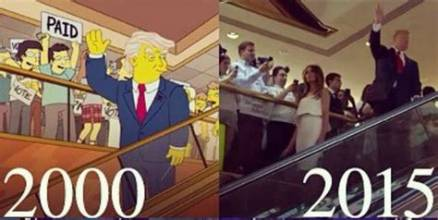
Seeing it materialize in real-time felt less like chance and more like a stage direction being executed with uncanny precision.
It serves as a stark reminder of what Joseph Stalin supposedly once quipped: it’s not the people who cast the votes that matter, but those who count them.
In this light, the ballot box feels less like an instrument of democracy and more like a formality, a quiet nod to a decision already reached behind the velvet curtains long before the polls even opened.
In the grand theater of American politics, we are encouraged to fixate on the noise—the shouting matches on cable news and the theatrical, irreconcilable differences displayed on the Senate floor.
We treat our politics as a contact sport, convinced that the victory of one side is the existential defeat of the other. But this partisan fervor is arguably the greatest misdirection in modern history.
If you look past the carefully curated antagonism, you might start to see the machinery beneath the floorboards. The Hegelian dialectic—a process of thesis, antithesis, and synthesis—is the engine of our political reality. A problem is presented (thesis), a heated reaction is generated (antithesis), and the ensuing tension is resolved by a solution (synthesis) that was likely planned from the very beginning.
It is a dance of controlled opposition. By keeping the electorate perpetually divided, the establishment ensures that our attention remains locked on the petty skirmishes of the culture war.
We fight over the “what” and the “who,” while the “where” is decided for us. When both parties seemingly converge on major issues—foreign policy, surveillance, or economic restructuring—it isn’t a coincidence or a rare moment of bipartisanship. It is the synthesis taking shape.
The illusion of choice is a powerful tool, one that prevents us from realizing that the “opposition” is often just another limb of the same body.



Leave a Reply